
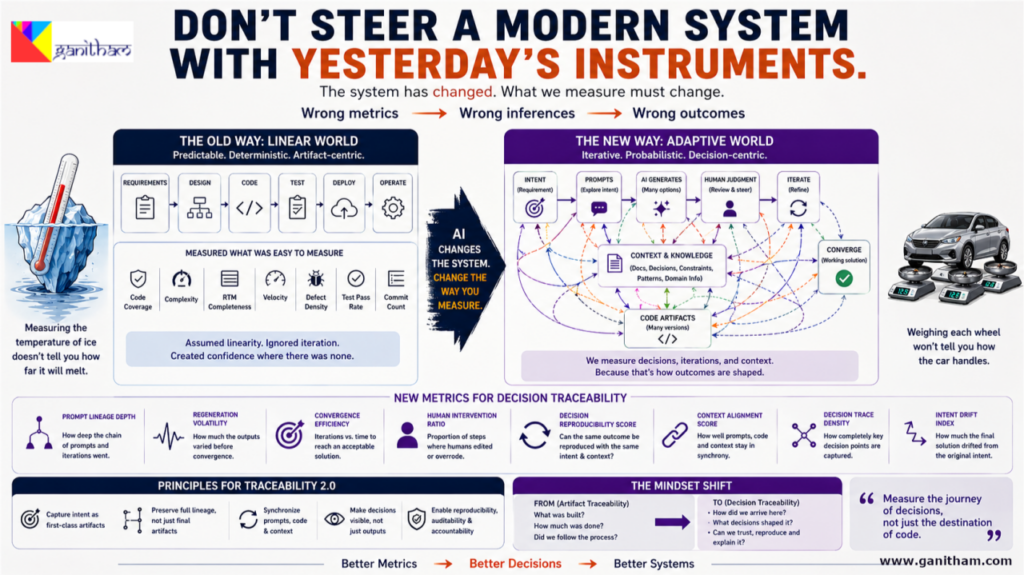
Traceability in the Age of AI: Why Our Metrics Are Quietly Failing
This is the fourth article in my series exploring how AI is quietly dismantling long-held assumptions in the Software Development Life Cycle. In the opening piece, I outlined six foundational beliefs now under pressure—from code as the primary unit of value to testing as the main defense against human error.
The next two articles examined how “cheap” AI-generated code can become an expensive strategic trap when leaders optimize for lower build costs instead of business outcomes, and how software has entered a post-human-author era where developers increasingly govern machine-generated outputs rather than author every line themselves.
This fourth article addresses Assumption #3: Traceability is linear and orderly. It is increasingly neither.
Assumption #3: Traceability is linear and orderly, Really?
For decades, traceability has been the backbone of disciplined software engineering.
Requirements mapped to designs. Designs translated into code. Code was validated through structured testing.
This linear chain enabled governance, auditability, and trust. Even when we iterated, we did so in controlled loops. That model worked—because the system itself was predictable.
AI-assisted development changes that assumption.
The Shift We Underestimated
In AI-assisted workflows, software is no longer constructed step-by-step. It is negotiated through iteration.
A requirement becomes a prompt. The prompt generates code. The developer modifies it. The AI regenerates a variation.
This loop repeats—often many times – even in parallel —before convergence.
The result is a working system. But the path that led there?
Fragmented. Partially visible. Seldom linear. Often lost.
The Illusion of Traceability
Despite this shift, most organizations still rely on familiar signals:
-
Code coverage
-
Complexity metrics
-
Requirement traceability matrices
-
Commit histories
-
Velocity
These indicators continue to report stability and control.
But they are measuring outputs—not decisions.
A system can appear fully traceable, while the reasoning behind it remains opaque.
That is not traceability. That is reconstruction.
What Actually Changed
Traditional traceability answered:
What was built, and how does it map to requirements?
Modern AI systems demand a different question:
How did the system arrive at this decision?
That distinction is not academic.
It affects:
-
Reproducibility
-
Accountability
-
Intellectual property clarity
-
Bias detection
-
Operational resilience
Why Prompts Alone Are Not Enough
There is a growing tendency to elevate prompts as first-class artifacts.
This is necessary—but insufficient.
Prompts evolve. Outputs influence subsequent prompts. Developers intervene between iterations.
A prompt without its lineage is incomplete.
Traceability now exists not in individual artifacts—but in their relationships.
A New Model: Synchronized Traceability
What emerges is a tri-layer model:
-
Prompts → capture intent
-
Code → captures execution
-
Context (notes, decisions, .md files) → captures reasoning
Traceability now depends on how well these layers stay aligned.
Lose that alignment—and the system becomes difficult to explain, reproduce, or govern.
Why Legacy Metrics Fall Short
Most existing metrics were designed for deterministic systems.
They assume:
-
Effort is visible
-
Decisions are explicit
-
Artifacts reflect reasoning
In AI-assisted systems:
-
Effort is compressed
-
Decisions are iterative
-
Artifacts are snapshots
This creates a dangerous gap.
We are measuring the stability of outputs while ignoring the volatility that produced them.
What Needs to Change
We need to move from:
-
Artifact traceability to Decision traceability
This requires new metrics that capture:
-
Iteration depth
-
Output stability
-
Decision reproducibility
-
Human intervention
-
Context alignment
This is not a tooling problem.
It is a measurement problem.
What We Are Exploring
In our ongoing work, we are testing these ideas in controlled environments:
-
A full-stack trading analytics platform
-
A database tuning workbench
-
Focused agentic development capabilities
These are not demonstrations.
They are systems designed to surface how AI actually shapes engineering decisions.
What Comes Next
This post introduces the problem.
Over the next few entries, I’ll break down:
-
Why code coverage is becoming a misleading signal
-
How prompt lineage changes traceability
-
Why velocity no longer reflects progress
-
What new metrics could look like in practice
Conclusion
Traceability has NOT become irrelevant.
But its assumptions have.
The systems have changed. The metrics must follow.
Where are you already seeing gaps between what your metrics report and what your systems actually do? Do share your views.
The complete Series:
· Starting Blog: Breaking the 6 Assumptions of the SDLC
· # 1: Why “Cheap” AI Code is an “Expensive” Strategic Trap
· # 2: The Ghost in the Code—Software’s Post Human-Author Era
· # 3: Traceability is linear and orderly
· # 4: Human readable code guarantees maintainability
· # 5: Effort predicts delivery
· # 6: Quality Engineering exists primarily to catch human mistakes
#ThinkInsideTheBox #AI #EnterpriseAI #SoftwareEngineering #AIGovernance #DigitalTransformation #EngineeringLeadership