
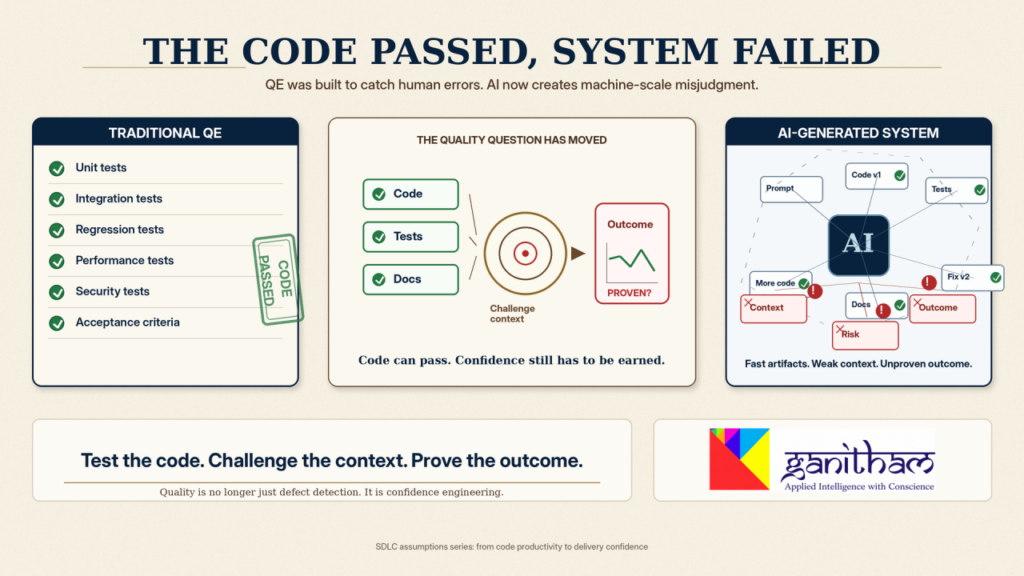
The Code Passed. The System Failed
This is the sixth article in my series exploring how AI is quietly dismantling long-held assumptions in the Software Development Life Cycle.
The earlier pieces examined how code is no longer the primary unit of value, why cheap AI-generated code can become strategically expensive, how software is entering a post-human-author era, why traceability is no longer linear, why clean code is no longer enough when context drifts, and why velocity is not delivery when effort stops predicting business progress.
The common thread is simple:
AI is not merely accelerating software delivery.
It is changing where delivery risk lives.
Assumption #6: Quality Engineering exists primarily to catch human mistakes. Really?
For decades, Quality Engineering has carried a clear and important burden: Catch what humans missed.
Missed requirements. Broken logic. Bad integrations. Regression defects. Performance bottlenecks. Security gaps. Usability issues. Release failures.
That model made sense.
Humans interpreted requirements, wrote the code, designed the test cases, reviewed the changes, and operated the system. Most software failures could be traced, at least partly, to human misunderstanding, omission, overload, or coordination breakdown.
So we built quality practices around that world.
Reviews. Test plans. Regression suites. Automation frameworks. Defect tracking. Static analysis. Security scans. Performance tests. User acceptance testing. Release gates.
These disciplines still matter.
But AI-assisted software delivery changes the failure model.
The new risk is not only that humans make mistakes while writing software.
The new risk is that software can now be generated from a misunderstanding, validated by tests generated from the same misunderstanding, documented with confidence, and shipped with a green dashboard.
That is a different animal.
And it bites quietly and the bite can be deadly.
Traditional QE was built around visible defects
Traditional Quality Engineering assumes that defects are discoverable deviations from expected behavior.
· A function returns the wrong result.
· An API fails under load.
· A screen breaks on mobile.
· A database constraint is missing.
· A workflow skips an approval.
· A calculation does not match the rule.
· A release breaks something that used to work.
These are classic software quality problems.
They are real. They are expensive. They are not going away.
But they are not the whole story anymore.
AI-generated software can look structurally correct while being conceptually wrong.
· The code may compile.
· The unit tests may pass.
· The integration may succeed.
· The documentation may read beautifully.
· The acceptance criteria may appear satisfied.
· The demo may impress the room.
And the system may still fail the actual business intent.
Why?
Because the defect is not always inside the code.
Sometimes the defect is inside the assumption that produced the code.
That is where traditional QE starts to look under-designed.
AI creates confidence-shaped errors
Human errors often leave fingerprints.
· Incomplete logic.
· Inconsistent naming.
· Missing branches.
· Awkward edge cases.
· Unclear comments.
· Patchy tests.
AI errors can be smoother.
They often arrive well-formatted, syntactically correct, pattern-aligned, and professionally explained. The output can feel coherent even when the underlying interpretation is wrong.
That is the dangerous part.
AI does not only produce defects.
It can produce confidence-shaped errors.
Errors that look reasonable.
Errors that follow familiar patterns.
Errors that satisfy generic tests.
Errors that hide missing context.
Errors that turn weak assumptions into executable behavior.
A human developer may leave a messy trail. AI may leave a polished one.
And polished wrongness is harder to catch than messy wrongness.
The code may pass because the test misunderstood the same thing
There is a particular trap in AI-assisted delivery that leaders need to understand.
AI can generate the code.
AI can generate the tests.
AI can generate the documentation.
AI can generate the release notes.
AI can generate the acceptance checklist.
Wonderful.
Now ask the uncomfortable question:
What if all of them share the same misunderstanding?
If the prompt missed a business exception, the generated code may miss it too.
If the story simplified a regulatory rule, the generated test may validate the simplified version.
If the model inferred the wrong workflow from similar examples, the documentation may confidently explain the wrong workflow.
If the enterprise context was incomplete, the solution may satisfy the visible requirement while violating the hidden operating reality.
That is not a testing gap in the old sense.
That is a context collapse.
Traditional QE asks:
Does the system behave as specified?
AI-era QE must also ask:
Was the specification itself complete, current, grounded, and tested against reality?
That is a much harder question.
It is also the question that now matters.
A banking example: KYC document upload
Consider a digital onboarding journey in banking.
A team is asked to implement a KYC document upload feature.
The user story says:
“As a customer, I want to upload KYC documents digitally so that I do not have to visit a branch.”
AI can help generate the upload screen, file validation logic, API endpoint, storage integration, status update, unit tests, UI text, and documentation quickly.
Traditional QE may verify:
· The upload works.
· Supported file types are accepted.
· Unsupported files are rejected.
· The document is stored.
· The workflow status is updated.
· The API handles expected errors.
· The screen works on target devices.
· Regression tests pass.
All necessary. Still not enough.
The real business and operational questions may be different:
· Does the customer know which document to upload?
· What happens when the document is partially readable?
· What if the name differs slightly across documents?
· What if the customer uploads a document valid for one segment but not another?
· What if branch-assisted customers behave differently from digital-native customers?
· What if the document passes technical validation but fails compliance review later?
· What if the upload reduces branch visits but increases back-office exceptions?
· What if the journey looks complete but onboarding cycle time does not improve?
The system may pass QE and still fail delivery. Not because the testers were careless. Because the quality question was too narrow.
The defect was not “file upload broken.” The defect was “business confidence not proven.”
QE must move from defect detection to assumption validation
This is the core shift.
In AI-assisted delivery, Quality Engineering cannot remain primarily a downstream function that catches implementation defects.
It must become an upstream and continuous discipline for validating assumptions.
· What assumptions shaped the story?
· What assumptions shaped the prompt?
· What assumptions shaped the generated design?
· What assumptions shaped the test cases?
· What assumptions shaped the acceptance criteria?
· What assumptions shaped the release decision?
Every meaningful software change now carries an assumption stack.
Business assumptions. User assumptions. Data assumptions. Workflow assumptions. Architecture assumptions. Security assumptions. Compliance assumptions. Operational assumptions. Model assumptions. Context assumptions.
AI accelerates the conversion of those assumptions into working software.
That is useful only if the assumptions are right enough to act on.
Otherwise, AI becomes an industrial printer for elegant mistakes.
The old test pyramid is not enough
The traditional test pyramid gave engineering teams a useful way to think about testing discipline.
Many unit tests. Fewer integration tests. Even fewer end-to-end tests. Some exploratory testing. Some performance testing. Some security testing.
That structure is still useful for software mechanics.
But AI-assisted delivery needs another layer.
Call it the confidence layer.
This layer does not ask only whether the code behaves correctly.
It asks whether the change deserves to exist.
· Does the story map to a measurable business objective?
· Does the generated behavior match the actual operating context?
· Are the edge cases grounded in real production patterns?
· Are the controls auditable?
· Can humans override the system when needed?
· Can the outcome be observed after release?
· Can the organization detect when the behavior drifts?
· Can the system explain its decision path under pressure?
· Can the business tell whether the change worked?
This is not traditional QA with a new hat.
This is a broader quality architecture. And yes, it sounds harder. That is because it is harder.
The shortcut era has consequences.
Generated tests are useful, but they are not judgment
AI-generated tests can be valuable.
They can improve coverage. They can produce boundary cases. They can speed up regression automation. They can help developers think through scenarios. They can reduce the drudgery of writing repetitive test cases.
Good. Use them.
But do not confuse generated test volume with quality confidence.
A model can generate many tests and still miss the one scenario that matters most.
· It may test common cases and ignore rare but expensive ones.
· It may validate the requirement as written and miss the requirement as lived.
· It may strengthen code confidence while doing nothing for business confidence.
· It may create a beautiful regression suite around the wrong behavior.
That is not progress.
That is a well-organized blind spot.
In the AI-assisted SDLC, the question is not:
How many tests did we generate?
The better question is:
Which risks did those tests actually reduce?
If nobody can answer that, the test suite is decoration.
Very disciplined decoration, perhaps.
Still decoration.
A claims automation example
Take insurance claims automation.
AI can help generate intake workflows, validation rules, triage logic, customer messages, fraud indicators, handler dashboards, and exception queues.
The visible delivery can move fast.
Traditional QE may verify:
· The claim can be submitted.
· Required fields are validated.
· Documents are attached.
· Rules execute correctly.
· Notifications are sent.
· Cases are routed to the correct queue.
· The dashboard displays the right fields. Again, necessary.
But the real quality questions are more consequential:
· Are vulnerable customers treated fairly?
· Can a claims handler override the recommendation?
· Are exceptions routed with enough context?
· Can the decision path be explained to a regulator?
· Does automation reduce settlement time without increasing dispute rates?
· Are low-risk claims accelerated without hiding fraud signals?
· Are customers given clear reasons when a claim needs review?
· Does the system learn from overrides and complaints?
The code may work. The workflow may pass.
The business may still inherit a fairness, trust, or regulatory problem.
That is not a minor defect.
That is quality failure at enterprise scale.
A trading analytics example
Now consider trading analytics.
AI can generate dashboards, anomaly detection workflows, natural-language query interfaces, alerting rules, and analyst summaries.
The delivery artifact may look impressive.
Traditional QE may verify:
· The dashboard loads.
· The query returns results.
· The alert fires.
· The latency is within threshold.
· The access controls work.
· The report exports correctly.
Useful.
But the deeper questions decide whether the system is safe to use:
· Where did the data come from?
· How stale is it?
· What assumptions shaped the alert?
· Can the analyst reproduce the result?
· Can the system distinguish signal from noise?
· Who is accountable when the recommendation is wrong?
· Can the lineage be reconstructed after an incident?
· Can the system explain itself when markets are moving fast?
No serious CXO wants faster analytics if the organization gets faster confusion.
The quality issue is not whether the dashboard works.
The quality issue is whether the system can be trusted when the stakes rise.
The Definition of Done is now too small
Many delivery teams still treat quality as something attached to a Definition of Done.
· Code complete.
· Peer reviewed.
· Tests passed.
· Acceptance criteria met.
· Security scan clean.
· Deployed to environment.
· Product owner accepted.
That was never the full story.
AI makes it visibly inadequate.
A story can meet its Definition of Done and still fail its business purpose.
A better model needs a Quality Definition of Done.
Not a bureaucratic monster. A sharper one.
For meaningful changes, the team should be able to answer:
· What business objective does this support?
· What assumption must be true for this change to matter?
· What evidence proves the assumption is valid?
· What edge cases could break the intended outcome?
· What generated artifacts need independent challenge?
· What data conditions could invalidate the behavior?
· What controls must be observable after release?
· What human judgment is required in exceptions?
· What deviation from expected outcome is acceptable?
· What will we do if the metric does not move?
That last question matters.
Because quality is not only pre-release correctness. Quality is post-release truthfulness.
Did the system do what the organization believed it would do?
If not, did we learn fast enough to change course?
QE becomes the discipline of confidence engineering
This is where Quality Engineering needs a new mandate.
· Not just test execution.
· Not just automation.
· Not just defect prevention.
· Not just release readiness.
Those remain important.
But the larger mandate is confidence engineering.
· Confidence that the requirement is grounded.
· Confidence that the context is current.
· Confidence that the generated logic is challenged.
· Confidence that tests cover business risk, not just code paths.
· Confidence that controls are built into the workflow.
· Confidence that the system is observable after release.
· Confidence that humans can intervene when needed.
· Confidence that outcomes can be measured.
· Confidence that learning feeds back into the system.
This is a much stronger role for QE.
It moves QE from the end of the delivery chain to the center of delivery governance.
That may make some organizations uncomfortable. Good.
Comfort is not a quality strategy.
What changes for engineering leaders
Engineering leaders should stop treating AI-assisted testing as merely a productivity improvement.
Yes, AI can generate more test cases. Yes, it can accelerate automation. Yes, it can help with regression maintenance. Yes, it can summarize defects and suggest fixes.
But the bigger opportunity is not faster testing. It is better risk selection.
Leaders should ask:
· Which assumptions are we testing?
· Which business risks are not covered by our test strategy?
· Which generated outputs need adversarial review?
· Which areas require human judgment before release?
· Which controls must be designed before implementation begins?
· Which post-release signals prove that the change worked?
This changes the quality conversation from activity to consequence.
That is overdue.
What changes for product leaders
Product leaders also need to adjust.
Acceptance criteria cannot remain a polite checklist for engineering completion.
In AI-assisted delivery, acceptance criteria must describe business behavior, not just system behavior.
Not only: “The user can upload a document.”
But: “The target user segment can complete onboarding with fewer assisted interventions, without increasing compliance exceptions.”
Not only: “The claim is routed automatically.”
But: “Low-risk claims are settled faster while preserving explainability, escalation quality, and fairness.”
Not only: “The dashboard displays alerts.”
But: “Analysts reduce investigation time for defined scenarios while preserving lineage and decision accountability.”
That is the difference between feature acceptance and outcome acceptance.
AI makes that difference impossible to ignore.
What changes for CXOs
For CXOs, the implication is blunt.
AI will make it easier for organizations to produce systems that look complete before they are truly understood.
That is the risk.
The wrong executive response is to ask for more automation, more generated tests, more velocity, and fewer people, then call the result transformation.
That is spreadsheet optimism wearing a hard hat.
The better response is to redesign delivery governance around confidence.
Not confidence as mood. Confidence as evidence.
· Evidence that the business objective is clear.
· Evidence that the assumptions are tested.
· Evidence that risks are controlled.
· Evidence that the system can be operated.
· Evidence that outcomes can be measured.
· Evidence that deviations will be detected.
· Evidence that learning will feed back into the next change.
This is what quality must mean in the AI-assisted enterprise.
The uncomfortable conclusion
Quality Engineering was never only about finding bugs. At its best, it was always about protecting trust.
But AI changes what trust requires. When software generation becomes faster, defect detection is not enough.
When tests can be generated, test volume is not enough.
When documentation can be produced instantly, explanation is not enough.
When dashboards turn green, status is not enough.
The real question becomes:
Have we earned enough confidence to believe this change will work in the real enterprise?
That confidence does not come from code alone.
It comes from tested assumptions, grounded context, observable behavior, accountable controls, and measurable outcomes.
The code passed. The test passed. The release passed.
Fine.
But did the business assumption pass? That is the new quality question.
And in the AI-assisted SDLC, Quality Engineering must stop being treated as the department that catches human mistakes.
It must become the discipline that catches machine-scale misjudgment before it becomes enterprise-scale damage.
A question worth asking
What would change in your delivery model if every release had to prove not only that the software worked, but that its core business assumptions survived contact with reality?
The complete Series:
· Starting Blog: Breaking the 6 Assumptions of the SDLC
· # 1: Why “Cheap” AI Code is an “Expensive” Strategic Trap
· # 2: The Ghost in the Code—Software’s Post Human-Author Era
· # 3: Traceability is linear and orderly
· # 4: Human readable code guarantees maintainability
· # 5: Effort predicts delivery
· # 6: Quality Engineering exists primarily to catch human mistakes
#ThinkInsideTheBox #EnterpriseAI #AIArchitecture #SoftwareEngineering #EngineeringLeadership #QualityEngineering #ResponsibleAI #DigitalTransformation