
Human-Readable Code Guarantees Maintainability. Really?
This is the fifth article in my series exploring how AI is quietly dismantling long-held assumptions in the Software Development Life Cycle. As systems become co-authored by humans and agents, the real risk may no longer be messy code—but Context Drift.
The earlier pieces examined how “cheap” AI-generated code can become strategically expensive, how software is entering a post-human-author era, and how traceability is becoming fragmented, iterative, and increasingly difficult to reconstruct.
This article builds on those shifts by examining Assumption #4: Human-readable code guarantees maintainability.
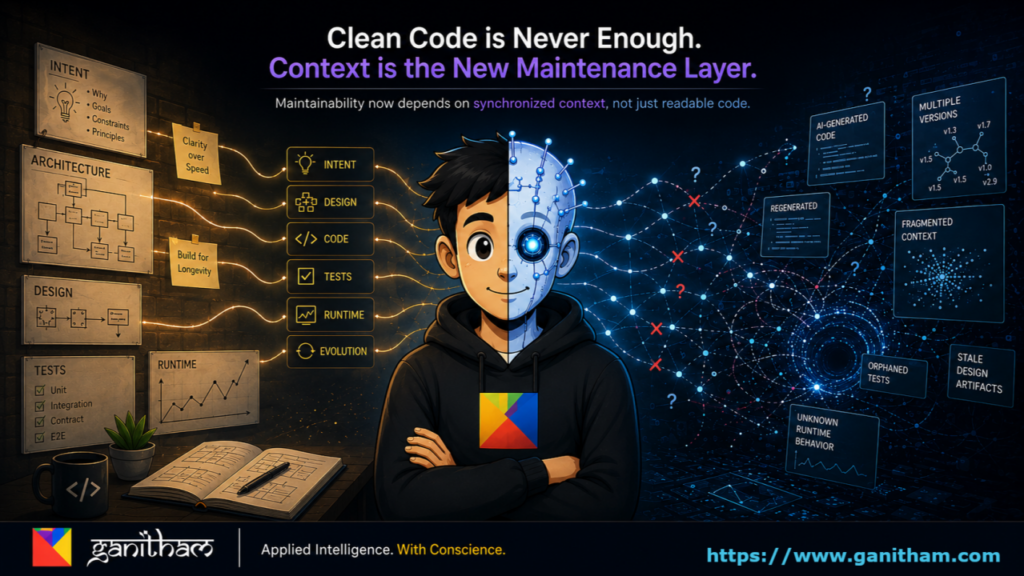
In AI-assisted systems, clean code is no longer enough. Maintainability increasingly depends on whether intent, design, code, tests, runtime behavior, and evolving context remain synchronized over time.
Assumption #4: Human-readable code guarantees maintainability.
For decades, we treated readable code as a proxy for maintainability.
Clean naming. Small functions. Sensible abstractions. If another engineer could understand your code, you had done your job.
It worked.
Because humans were the primary authors—and the primary readers.
That assumption is now under pressure.
What changed (quietly, but completely)
By now, the pattern should be familiar:
-
Code is no longer scarce
-
Humans are no longer the sole authors
-
Systems are no longer built in clean, traceable sequences
Put these together, and something fundamental shifts:
Code is no longer the primary carrier of understanding.
But our practices still behave as if it is.
The illusion of maintainability
You walk into a modern codebase and everything looks right:
-
Clean, structured code
-
Meaningful naming
-
High test coverage
-
Passing pipelines
All signals are green.
And yet, making a simple change feels risky.
Not because the code is messy.
Because no one is entirely sure:
-
Why this logic exists
-
Which assumption it encodes
-
What trade-off it represents
-
Whether it still aligns with intent
The system is readable.
But it is no longer understandable.
A very modern failure
A requirement becomes a prompt. The prompt generates a module. The developer tweaks it. The AI regenerates a variation. Tests are added—some generated, some written.
The system stabilizes.
Then the micro-iterations begin:
-
Edge cases fixed via quick prompts
-
Performance tweaks applied directly in code
-
Tests evolve to validate current behavior
-
AI refactors improve structure
Everything looks disciplined.
Meanwhile:
-
Design documents quietly go stale
-
Architecture diagrams drift
-
Decision rationale dissolves into iterations
-
Prompt lineage becomes incomplete
Fast forward three months.
The code is clean. The tests pass.
Ask a simple question:
“Why does this behave this way?”
You’ll get multiple answers.
Everything is readable. Nothing is fully understandable.
Where understanding actually lives now
We optimized code for readability because that’s where understanding had to live.
That is no longer true.
Today:
-
Humans understand systems through: natural language artifacts diagrams architectural abstractions decision notes
-
Machines operate across everything: code tests prompts documentation runtime signals
Code is no longer the bottleneck of comprehension. Code is just one artifact among many.
From Clean Code to Clean Context
Clean Code is still necessary.
But it is no longer sufficient.
We need to move from:
Clean Code to: Clean Context
Clean Context is not about how code reads.
It is about how well the system stays aligned across:
-
Intent
-
Design
-
Code
-
Tests
-
Runtime behavior
-
Evolution over time
The mechanism behind this: Synchronized Context.
Not staged handoffs. Not occasional documentation updates.
But continuous, two-way alignment across artefacts.
Let’s demystify “context”
Today, “context” is often reduced to:
-
prompt engineering
-
memory windows
-
retrieval pipelines
That’s not context. That’s input state.
You can have perfectly engineered prompts and still end up with an unmaintainable system—
if your design, code, tests, and runtime behavior drift apart.
Context is not what you pass into a model. Context is what keeps a system coherent over time.
What actually breaks
Most engineering workflows still assume:
-
Design leads, code follows
-
Documentation captures intent
-
Tests validate correctness
In AI-assisted development:
-
Code evolves faster than design
-
Tests validate behavior, not intent
-
Documentation becomes reconstruction
The result is not messy code.
The result is context erosion.
And once context erodes, maintainability collapses—quietly.
What needs to change
We don’t need more/less discipline. We need different discipline.
-
Design artifacts must become living systems
-
Synchronization must be continuous
-
Artifacts must evolve bidirectionally
Maintainability is no longer about reading code. It is about preserving alignment over time.
A question worth asking
If your code is clean, your tests are green, and your pipelines are stable—
but your intent, design, and behavior are drifting apart…
Is your system actually maintainable?
More importantly:
What have you changed to ensure context stays synchronized— between humans and the systems now co-authoring your software?
The complete Series:
· Starting Blog: Breaking the 6 Assumptions of the SDLC
· # 1: Why “Cheap” AI Code is an “Expensive” Strategic Trap
· # 2: The Ghost in the Code—Software’s Post Human-Author Era
· # 3: Traceability is linear and orderly
· # 4: Human readable code guarantees maintainability
· # 5: Effort predicts delivery
· # 6: Quality Engineering exists primarily to catch human mistakes
#ThinkInsideTheBox #AI #EnterpriseAI #SoftwareEngineering #AIGovernance #DigitalTransformation #EngineeringLeadership