
Why “Cheap” AI Code is an “Expensive” Strategic Trap
In my recent analysis of How AI is Breaking the 6 Assumptions of the SDLC, I argued that Assumption #1—that Code is the primary unit of value—is officially dead.
But if code isn’t the value, then what exactly are we paying for?
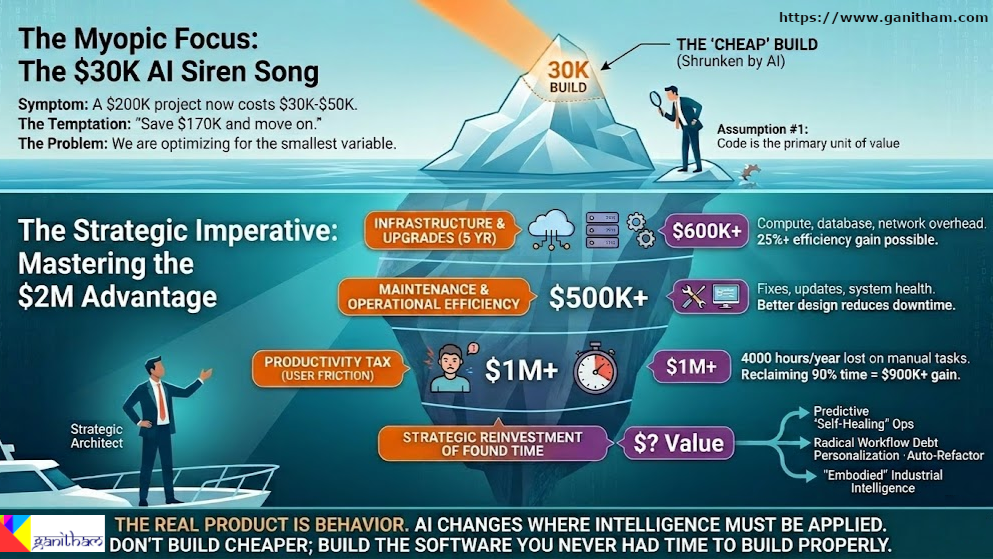
The Iceberg of Enterprise Software
For decades, we managed software projects as if the “build” was the finish line. Writing reliable code was so expensive and scarce that we built our entire management philosophy around it.
In that era, a typical $2M economic footprint looked like this:
-
Development: $200K (The visible tip)
-
Infrastructure & Maintenance: $1.1M (The weight below the water)
-
The Productivity Tax (User Friction): $1M+ (The hidden cost of bad design)
We spent every board meeting obsessing over the $200K because it was the only number that felt controllable. We ignored the millions leaking out of the bottom of the boat.
The Siren Song of the $30K Project
AI has arrived to collapse the cost of generation. That $200K dev bill is now, theoretically, $30K–$50K.
The temptation for the C-suite is obvious: “Let’s bank the $150K savings and move on.” This is a strategic trap. If you treat AI as a mere coupon for cheaper labor, you are optimizing for the smallest variable in your business.
The real cost of software is no longer the developer’s invoice—it is the behavior the system creates across your organization.
The Real Opportunity: Reinvesting “Found Time”
Instead of shrinking the project budget to $30K, a savvy leader keeps the investment at $150K but redirects the “freed up” engineering capacity into high-leverage domains that were previously “too expensive” to touch.
Here is what that reinvestment looks like in the real world: (Not exhaustive. Do leave your views in the comments please)
1. Predictive “Self-Healing” Operations
Most enterprise systems are reactive—they wait for a crash to trigger a ticket.
-
The Reinvestment: Use freed-up cycles to build Agentic Observability. * Real-World Case: A global logistics provider used reallocated engineering time to build an AI layer that monitors “chatter” between microservices. Instead of waiting for a crash, the system now predicts database deadlocks based on traffic patterns and auto-scales before the outage occurs.
-
Result: Reduced “Sev-1” incidents by 40%, saving an estimated $300K/year in emergency remediation.
2. Radical Personalization of Workflows (The Friction Killer)
Consider the humble expense report. It usually takes a Director ten minutes of clicking and uploading—a $1M productivity tax over five years for a 2,000-person firm.
-
The Reinvestment: Shift from “Static UI” to “Intent-Based UX.” * Real-World Case: A major financial firm redirected developers from building manual reporting screens to creating a “Data Concierge.” Instead of managers spending 30 minutes prepping for a client meeting, they now ask: “Summarize this client’s risk vs. current volatility.”
-
Result: Reclaimed 4 hours per week for 500 managers—the equivalent of adding 50 new full-time employees to the front line for free.
3. Curing the “Disease” of Technical Debt
We often ignore the “spaghetti code” of legacy systems because “shipping new features” is the priority.
-
The Reinvestment: Use AI-guided agents to Auto-Refactor Legacy Core.
-
Real-World Case: A retail giant used their found capacity to modularize a 15-year-old monolithic ordering system.
-
Result: They slashed “Time-to-Market” for new features from 6 months to 2 weeks. They didn’t just build faster; they made the entire organization more agile.
The New Bottom Line
In the pre-AI world, the constraint was Generation (How do we write this?). In the post-AI world, the constraint is Design (How should this behave?).
If code is no longer the unit of value, the “product” is now the speed at which your company moves. The ease with which your people make decisions. The fluidity of your operations.
The real strategic question of the AI era isn’t: “Can we build this cheaper?” It is: “Can we finally afford to build the software we actually needed?”
Don’t settle for a $170K discount when you could have a $2 million advantage.
The complete Series:
· Starting Blog: Breaking the 6 Assumptions of the SDLC
· # 1: Why “Cheap” AI Code is an “Expensive” Strategic Trap
· # 2: The Ghost in the Code—Software’s Post Human-Author Era
· # 3: Traceability is linear and orderly
· # 4: Human readable code guarantees maintainability
· # 5: Effort predicts delivery
· # 6: Quality Engineering exists primarily to catch human mistakes
#GenerativeAI, #DigitalTransformation, #SoftwareEconomics, #ProductivityTax, #EnterpriseArchitecture, #CXOInsights