
Article | February 4, 2026
The SaaSpocalypse & The Rise of the Agent: A New Economic Order
Abstract
The financial markets are witnessing an unprecedented revaluation. The past 72 hours have seen a “SaaSpocalypse” triggered by Anthropic’s Claude Cowork and its “vertical plugins,” leading to a projected $285-$300 billion erosion in enterprise software valuation. This event marks the rapid transition from “Human-in-the-Loop” to “Agent-in-Control” paradigms across IT services, SaaS, and ancillary urban economies. This report analyzes the immediate impact, evaluates the “Jevons Paradox” argument for IT service growth, and outlines the emerging economic landscape for Indian IT cities. Data indicates a fundamental shift from headcount-linked growth to “orchestration-as-a service,” demanding urgent strategic recalibration for incumbents.
The market correction commencing February 3, 2026, was not merely a reaction to enhanced AI capabilities, but a recognition of Anthropic’s shift from model provider to application provider. The release of Claude Cowork with its 11 pre-built, domain-specific agents, particularly the “Legal Plugin,” demonstrated end-to-end autonomous workflow execution.
Key Triggers & Market Response (Feb 3-4, 2026):

This immediate revaluation reflects investor understanding that the “per-seat” revenue model, cornerstone of modern SaaS, is structurally challenged when a single AI subscription can subsume dozens of human-equivalent licenses.
2. Competitive Landscape: Accelerating the Cannibalization Cascade
The initial Anthropic shockwave is merely the first in a series of anticipated “Agentic Assaults” from major AI players. Competition is not merely for model superiority but for workflow dominance.
This multi-front offensive ensures that the cannibalization will intensify, extending beyond front-office SaaS to back-office automation and traditional IT service lines.
3. Re-evaluating Indian IT Exports: The Jevons Paradox vs. Margin Erosion
The core debate centers on the Jevons Paradox: will reduced costs of project execution lead to a surge in demand that offsets margin compression, or will the efficiency gains simply obliterate traditional revenue streams?
Argument 1: The "Growth Through Volume" Hypothesis (Bull Case)
- Premise: AI agents drastically lower the cost of application development and integration, unlocking a vast backlog of previously uneconomical projects.
- Mechanism: A project costing $50,000 becomes $500. Enterprises will greenlight thousands of these “micro-projects,” leading to increased demand for “Orchestration Services” (human architects overseeing agent fleets).
- Potential Outcome: A shift from high-value, low-volume projects to high-volume, lower-margin “Agent-as-a-Service” engagements, potentially maintaining overall revenue.
Verdict: Short-Term Slowdown, Long-Term Transformation
Current data (Feb 4, 2026) strongly suggests a short-term slowdown as the market aggressively reprices labor arbitrage. The Nifty IT Index’s -5.87% drop indicates immediate investor flight from headcount-linked growth.
Longer-term, the “Orchestrator-in-the-Middle” concept represents the viable path forward. However, this is not a growth model for tens of thousands of entry-level engineers but for highly skilled “Agent Fleet Managers” and “AI Governance Experts.”
4. Impact on Indian Urban Economies: The "Two Indias" Divergence
The shift from “Human Labor IT” to “Agent Orchestration” is profoundly reshaping the urban economic landscape of India’s tech hubs.
Urban Economic Impact Summary (Feb 2026):
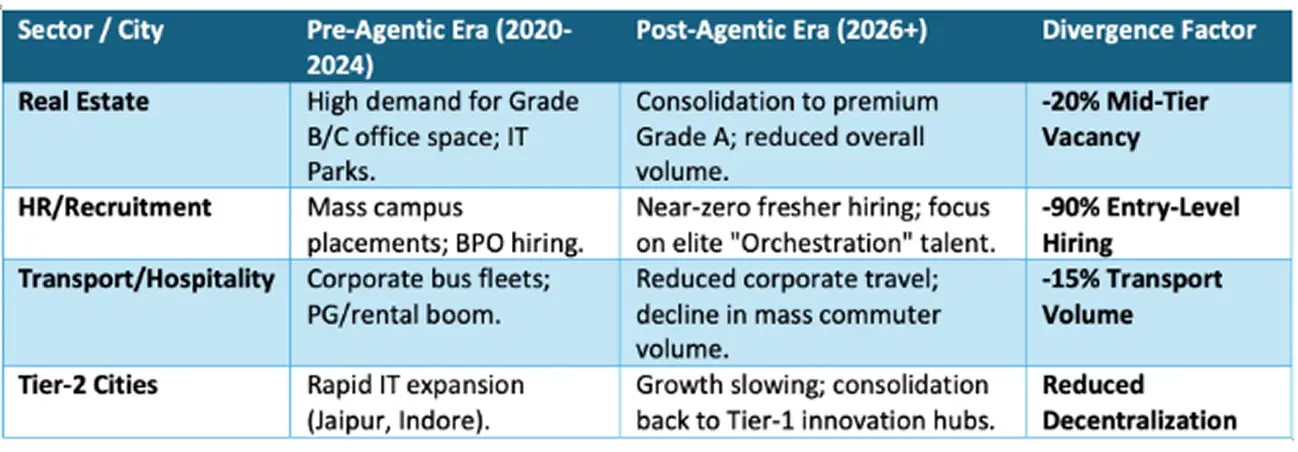
The “Middle IT Class” that fueled these economies is at risk. Wealth concentration will shift towards a smaller, highly specialized “AI Elite,” leading to a widening socio-economic gap within these tech cities.
5. The Path Forward: Embracing "Agentic Sovereignty"
For Indian IT to thrive, the strategic imperative is to pivot from “Cost Arbitrage” to “Process & Intelligence Arbitrage.”
- EU Opportunity: The EU AI Act (effective Aug 2026) creates a temporary shield, mandating human oversight for “High-Risk” AI systems. Indian firms can offer “Sovereign AI Services” as human-led AI governance and ethical orchestration.
- The Orchestrator: The future lies in providing expert “Agent Orchestration” platforms—managing sophisticated AI fleets for clients, ensuring compliance, security, and integration with legacy systems using protocols like Anthropic’s Model Context Protocol (MCP).
- Deep Verticalization: Specializing in complex domains (e.g., Agri-Fintech, Healthcare AI) where human judgment and ethical considerations are paramount, augmented by AI, not replaced by it.
The market has spoken. The “SaaSpocalypse” is not a temporary blip but a fundamental re-architecture of the digital economy. Survival and growth now depend on who can most effectively harness and orchestrate the emerging AI agent workforce.
Where does this apply to you?
If something here resonates, we’re open to a thoughtful discussion.