
Article
Indian IT Services and Agentic AI: A Structural Shift, Not a Slow Evolution
For nearly three decades, Indian IT services has been one of India’s most successful industrial stories. It didn’t just create large companies. It created an ecosystem.
From the mid-1990s to today, India built a global delivery model that became essential for enterprises worldwide. Today, India’s technology sector employs nearly 5.8 million professionals, contributes about 7.3% of India’s GDP, and generates technology exports close to $200 billion annually.
That is not a small achievement. It is one of the largest sustained export engines India has ever built.
But the next chapter will not look like the last one.
The India IT Story Was Built on Reinvention
Indian IT services has repeatedly adapted to major technology shifts:
-
Unix and distributed computing
-
Y2K remediation
-
ERP implementations
-
Mobile and digital channels
-
Cloud migration
-
Data platforms and analytics
Every wave created new work. And the industry scaled by doing what it does best: industrialising execution.
The global outsourcing boom built not just companies, but trust.
Enterprises across the world learned that if they wanted to modernise, scale, or digitise faster, they needed an “India story” somewhere in their delivery model.
That model worked spectacularly well.
But GenAI Is Not Another Wave
Generative AI, and more specifically agentic development, is not a new technology layer.
It changes the production model itself.
For the first time, software engineering tasks that were assumed to be “human-only” are being automated at scale:
-
code generation
-
test case creation
-
documentation
-
refactoring
-
bug fixes
-
CI/CD pipelines
-
even architecture prototyping
This isn’t just automation of routine work.
It is the beginning of AI-first software delivery, where humans increasingly supervise outcomes rather than execute every step. Reading and reviewing code and results is more important than writing, debugging, testing and deploying code
This is why this shift is not incremental. It is structural.
Why This Feels Like Y2K (Though Without a Deadline)
The closest parallel is Y2K. Y2K was urgent because the deadline was fixed and the after effects were huge and non-diversifiable risk without transforming the code
Agentic AI is urgent because core competitiveness is at stake.
Organisations that fail to improve IT ROI and delivery velocity through AI and automation will become non-competitive in their own industries. This ensures that even the most supporting and benevolent customers cannot afford to wait for their IT services vendors to “catch up”
The pressure is immediate, contiguous and huge. The clock is not a calendar. The clock is market survival.
Four Structural Shifts Indian IT Services Must Make
1. Workforce Model: From Pyramid to Diamond
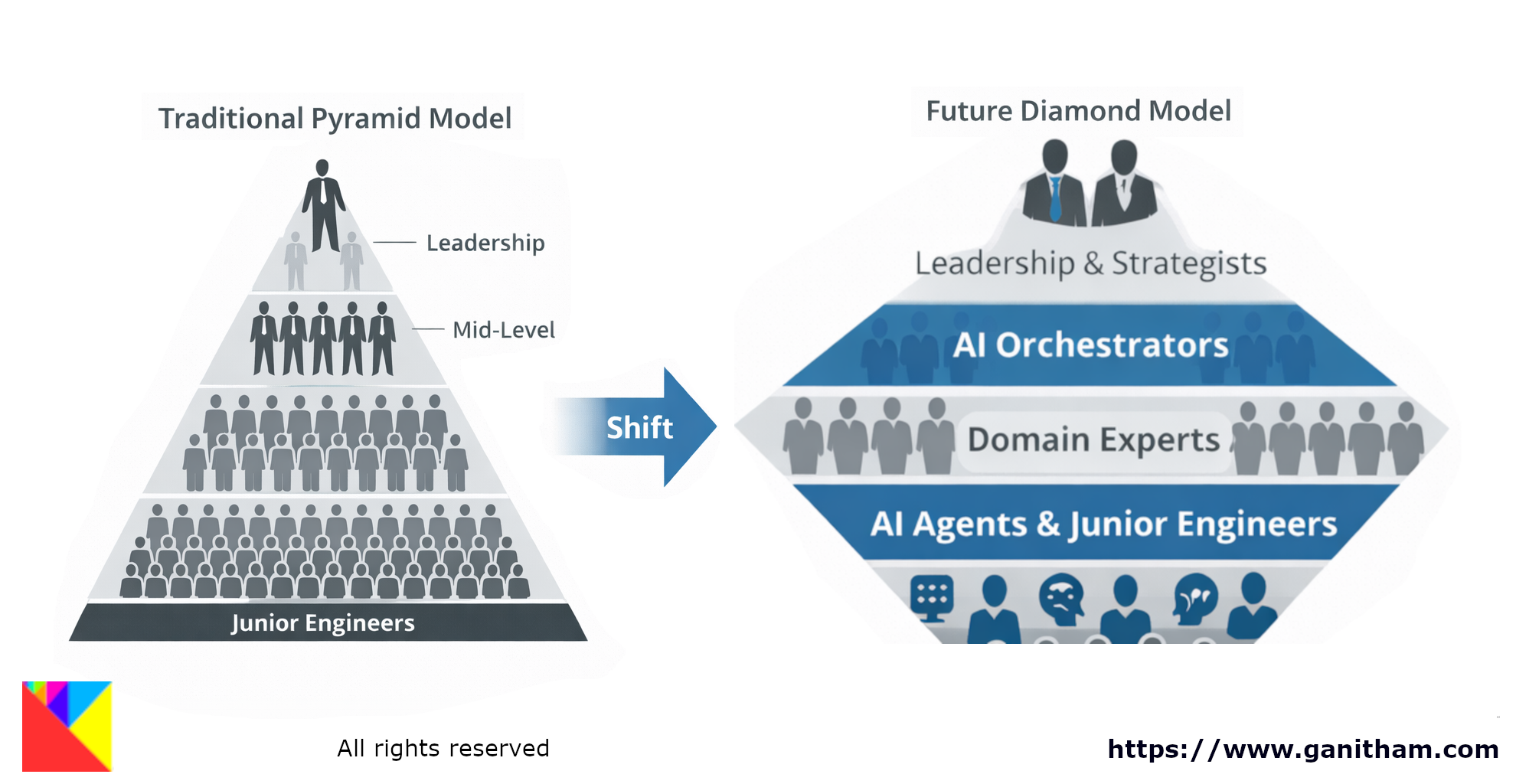
The traditional IT services model was built on a pyramid:
-
large numbers of junior engineers at the base
-
fewer mid-level engineers
-
thin leadership at the top
That model scaled beautifully because entry-level engineering work was abundant and decomposable.
Agentic AI compresses that base.
The future organisation looks like a diamond:
-
a narrower junior layer
-
a wider middle of experienced engineers and domain specialists
-
orchestrators supervising AI agents
-
strong leadership and strategic architects
Junior hiring won’t disappear. But it will reduce in volume and increase in quality.
The bottom of the pyramid will no longer be only humans. It will be a hybrid layer of agents + junior engineers.
2. People Transformation: Two Changes, Not One
This is the most critical shift. And it has two parts.
A. College Partnerships Become a Must-Have
India’s engineering education system expanded massively over the last two decades because IT services hiring scaled massively.
Private engineering schools and training ecosystems grew because the pipeline was predictable: engineering degree → placement → job with an IT services provider.
That pipeline is now shaky and will lose relevance soon.
The future model will require deeper partnerships. Something like:
-
companies select students earlier (4th or 5th semester)
-
remaining curriculum is co-designed and made to order
-
internships become structured and mandatory, may be the entire final year is spend on working closely with agents to produce production ready outputs
-
employability becomes the primary objective, not an undergraduate degree
This isn’t only about IITs and NITs. To succeed IT services companies will have to partner early with 200–400 engineering schools across India. There are multiple models possible here. More on this later.
B. The Technologist Stops Being a Commodity
In traditional IT services, technologists were often treated as SKUs.
Customer-facing roles were the stars. That hierarchy will not survive in that form alone. Ofcourse, there will be massive changes on the consuming side as well. We can ponder on this at a later stage.
The new hero is the GenAI pipeline orchestrator—someone who can supervise agents, manage workflows, implement guardrails, run evaluation systems, and ensure compliance in AI-driven delivery.
This is not a niche role. It becomes the core of delivery.
And this also changes the role of R&D and L&D.
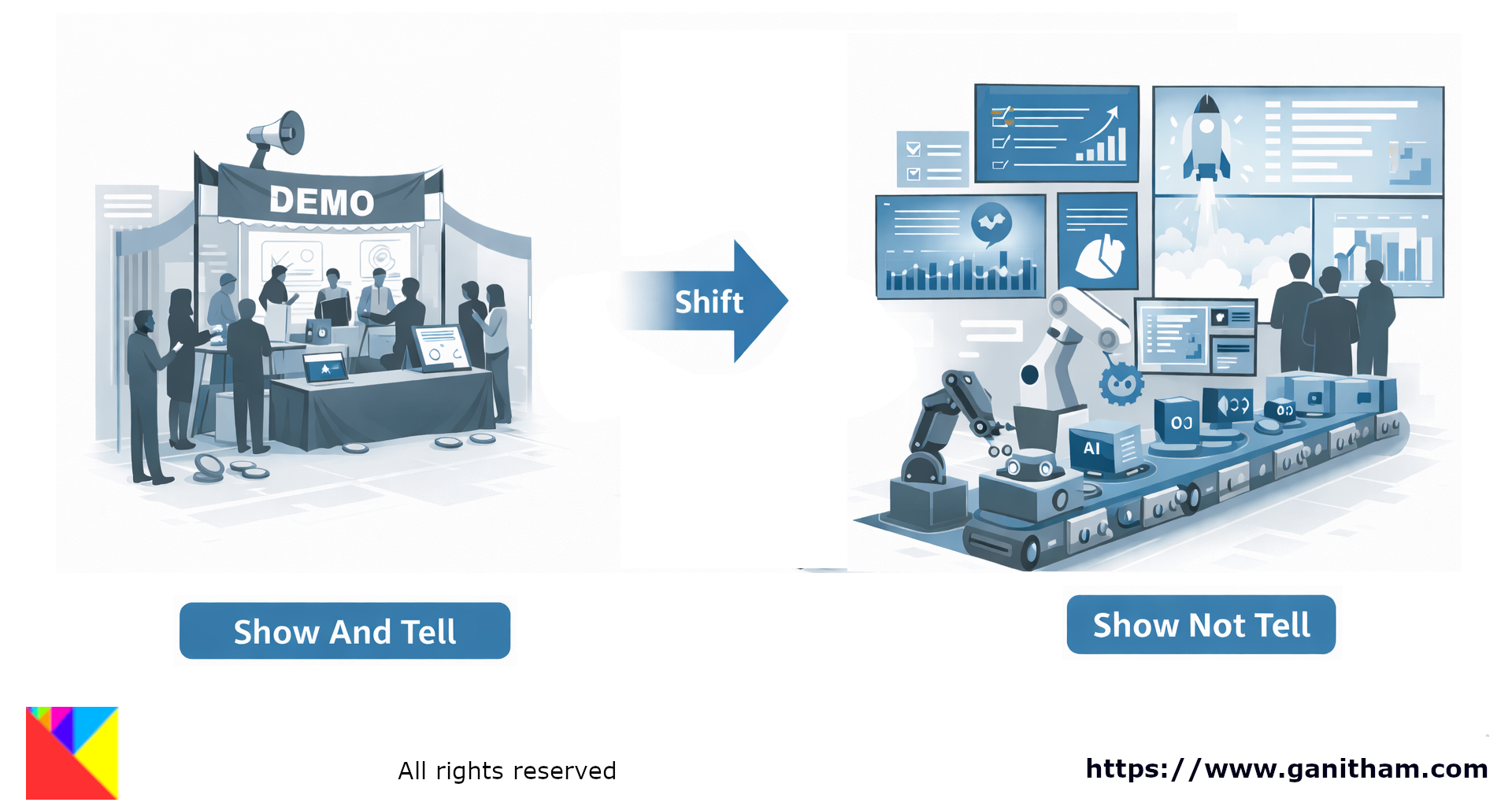
From “Show and Tell” to “Show, Not Tell”
Historically, much of IT services R&D was positioned as:
-
Demo labs
-
PoCs and pilots
-
Media showcases
-
Conversation starters
That worked when innovation was optional. This meant a strategic blindness towards R&D resulting in inadequately funded, wrongly staffed R&D units.
In the AI era, innovation is not optional. R&D cannot remain a fringe unit. It must become the production and sales engine.
The mandate becomes simple: “Show, Not Tell”. The outcomes / innovation / platforms should them selves tell the story.
Reusable accelerators must ship and should be differentiators. AI assets must run in production. Platforms must deliver objective and measurable outcomes.
Similarly, L&D cannot remain a certification factory which is their current role. It must evolve into an internal university—nurturing innovators and orchestrators at scale.
This is where the cash reserves of Indian IT firms become a strategic weapon.
Commercial Model: Billing Inputs to Delivering Outcomes
Even when contracts are “fixed price” most are still fixed-input models.
Clients pay for:
-
effort
-
headcount
-
scope commitments
AI breaks this.
As automation reduces effort, clients will increasingly demand outcome-based engagement and to defend top line that will be the only option left for IT Service providers. This will lead to:
-
productivity improvement
-
faster release cycles
-
reduced defects
-
measurable cost reduction
-
engineering ROI
This transition requires new commercial frameworks and risk-sharing models.
But it also creates differentiation.
The winners will not be those who provide the cheapest engineer. The winners will be those who can confidently deliver measurable outcomes economically.
Value Stack: Execution to Advisory
Indian IT services firms already understand enterprise workflows deeply.
They have implemented the backbone systems of:
-
banks
-
retailers
-
insurers
-
telecom operators
-
logistics companies
-
wealth managers
What they need is to move up the stack: from operational execution → to strategic advisory and workflow ownership.
GenAI makes this possible because it can generate playbooks, scenarios, and domain frameworks at scale.
This does not eliminate consulting firms.
But it reshapes the consulting value chain—and creates an opportunity for IT services firms to expand into AI-native advisory.
This will become critical and necessary condition for success.
The Most Important Line
Here is the uncomfortable truth:
Agentic development won’t kill Indian IT. But it will kill the comforting lie that headcount growth equals industry growth.
The next era will reward those who grow:
-
outcomes per engineer
-
automation per workflow
-
velocity per dollar invested
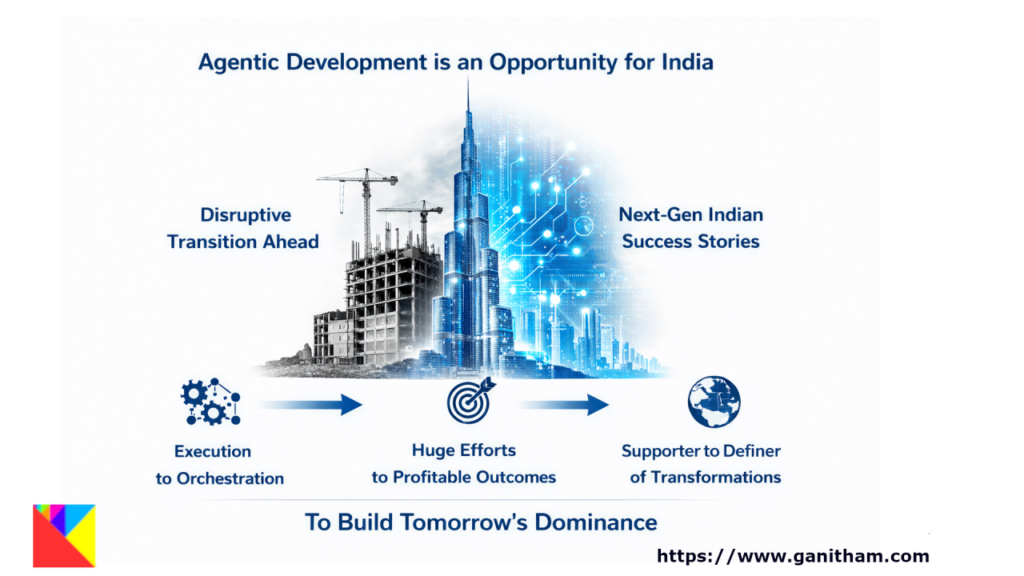
The ‘Burj Khalifa’ Moment
The outsourcing boom created a massive foundation: jobs, exports, foreign exchange, and one of the world’s largest technology ecosystems.
But that was not the destination. It was the foundation.
If the last 30 years built the concrete base, the coming decade will determine whether India builds the technology equivalent of a Burj Khalifa—an AI-native skyscraper of global innovation and outcome-led delivery.
Yes, the transition will be disruptive.
But it will also create the next generation of Indian success stories—firms that move from execution to orchestration, from billing effort to delivering outcomes, and from supporting global transformation to defining it.
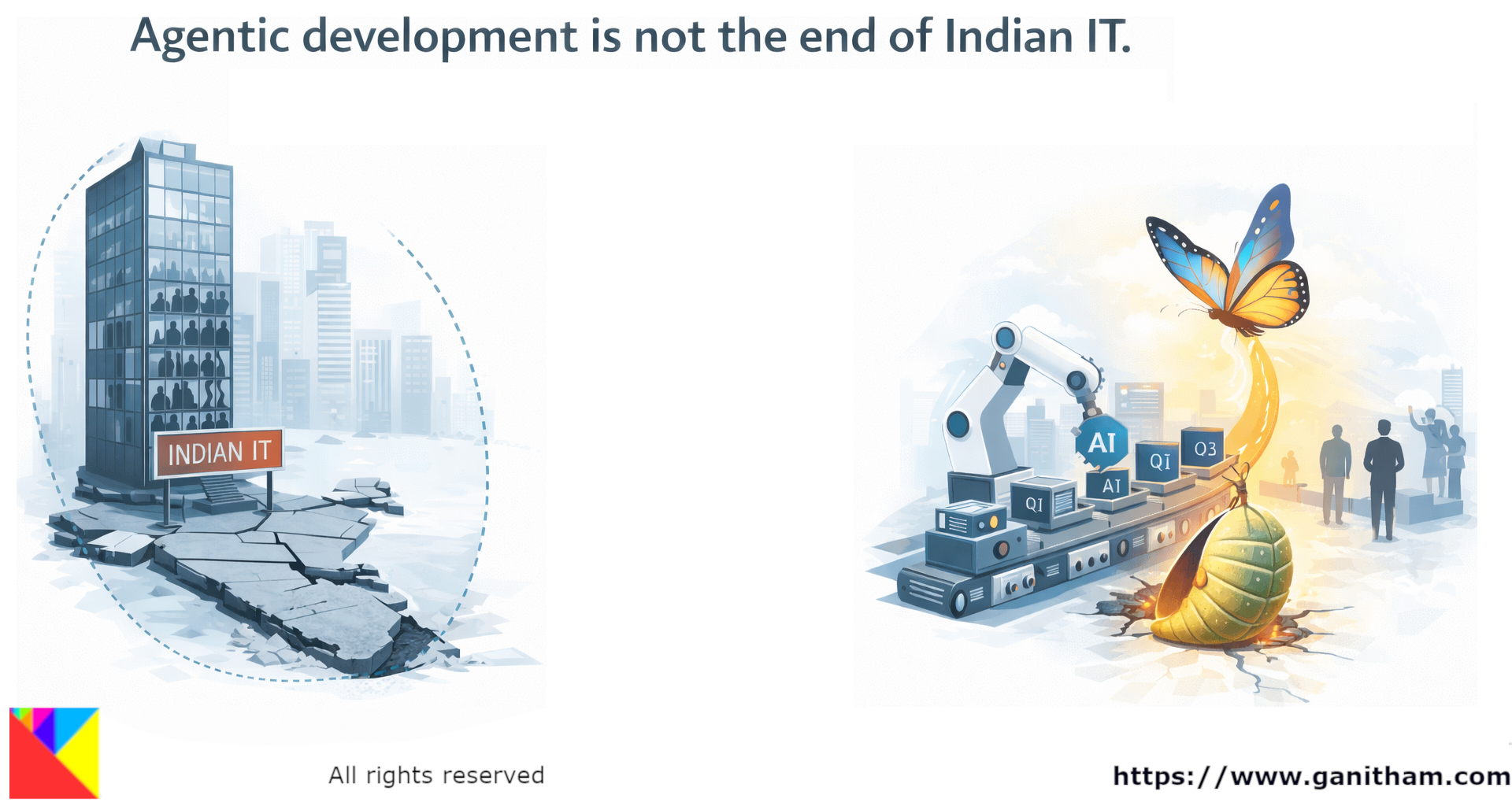
The opportunity is not to defend yesterday’s advantage. The opportunity is to build tomorrow’s dominance.
This blog is a condensed version of a longer framework and part of an imagineering series
If you’d like the full industry whitepaper (with detailed tables, workforce/industry data, and a structured transformation playbook), message me at subscribe@ganitham.com.
If you found this useful, feel free to share it with leaders in IT services, enterprise CIO offices, and engineering education institutions. This transition is bigger than any single company. You can also tag them in the comments.
Where to start
Every firm is different, so we start by listening. A 30-minute call is enough to see where AI fits first.
Book a 30-minute call