
Article
The New Division of Cognitive Labour
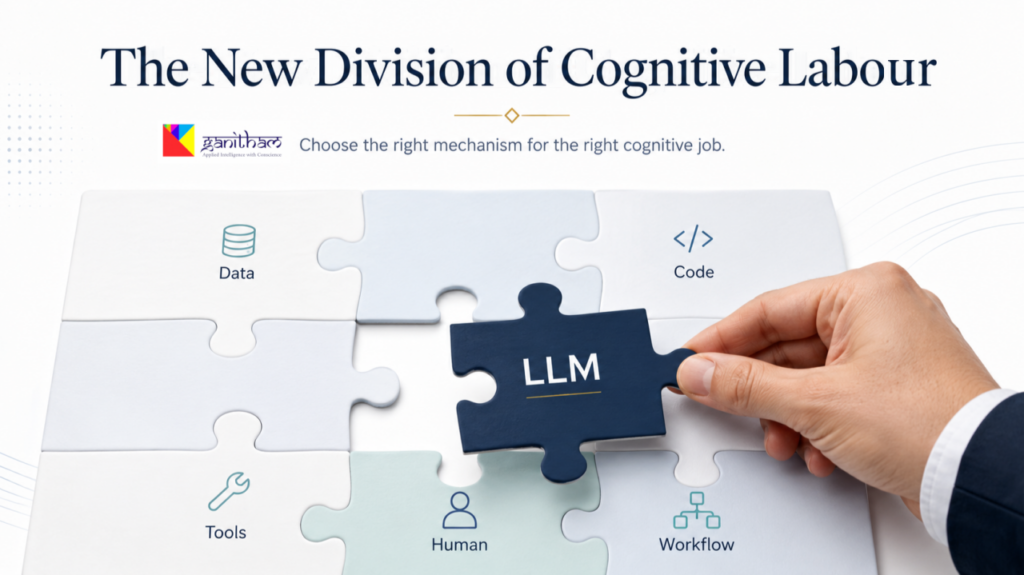
Enterprise architecture has always been about division of labour.
Databases store. Pipelines move. Code calculates. Search retrieves. Rules enforce. Statistical models predict. Workflows control process and state. Humans interpret, decide and handle exceptions.
None of that is new.
What is new is the arrival of a broadly useful mechanism that can interpret language, synthesise context and work across information that was previously difficult or expensive to encode into conventional software.
LLMs do not invent the discipline of separating responsibilities.
They change the allocation problem.
The enterprise question is therefore not:
Where can we use an LLM?
It is:
Which cognitive responsibility exists here, which mechanisms can perform it, and why should the LLM get the job?
That is the new division of cognitive labour.
The allocation problem
For years, enterprise systems have assigned different kinds of work to different mechanisms.
If revenue can be calculated exactly, calculate it.
If customer exposure is held in a system of record, retrieve it.
If a policy can be expressed as rules, enforce those rules.
If a statistical model estimates risk reliably, use the model.
If an approval must follow a known sequence, use a workflow.
LLMs enter this architecture with a different strength: interpretation and synthesis across language, ambiguity and context.
Capability and architectural suitability are different things.
An LLM may be able to calculate, classify, retrieve, recommend and even act. That does not mean all those responsibilities should be delegated to it.
Conversely, this is not an argument for surrounding every LLM with twelve conventional systems simply because that feels architecturally respectable.
Sometimes an LLM may legitimately perform several responsibilities because doing so produces the simplest reliable system.
The principle is mechanism-neutral:
Use the simplest overall system that provides the required capability, assurance and economics.
The LLM has to earn its place.
So does everything else.
Use a responsibility lens
A useful way to examine a business process is through a set of responsibility lenses:
Data → Measures → Observations → Evidence → Claims → Judgements → Recommendations → Decisions → Actions
These are not mutually exclusive categories, and they are not a runtime pipeline.
The same artefact may play several roles depending on the decision being made. A defect rate can be a measure, an observation and evidence. A retrieved incident report can be data in one context and evidence in another.
Real systems also loop. They gather more evidence, revisit claims, retry actions and escalate exceptions.
The purpose is simply to make responsibilities visible.
Data
What information enters the process?
Transactions, events, documents, telemetry, messages.
Measures
What should be calculated?
Revenue, variance, exposure, ageing, probability, concentration.
If the answer can be computed exactly, generation usually adds little.
Observations
What current or authoritative state must be retrieved?
Was the shipment delivered? What contract is active? What is the customer’s balance now?
Evidence
What substantiates an important claim?
A model saying something confidently does not make it evidence.
Claims
What assertions can reasonably be made from that evidence?
“Supplier reliability has deteriorated.”
Judgements
What does that claim mean in context?
“Supplier X now represents elevated operational risk.”
This may be where an LLM helps—especially when the evidence sits across contracts, correspondence, incident notes and other unstructured material.
But it may also be where a rules engine, statistical model or human performs better.
Recommendations
What should happen next?
“Reduce exposure and qualify an alternative supplier.”
Decisions
Who has authority to accept, reject or modify that recommendation?
Not every decision requires a human click.
What matters is that decision rights and delegation envelopes are explicit.
Actions
What gets executed?
And how are state, permissions, escalation, containment and traceability controlled?
One component may perform several of these responsibilities. One responsibility may also require several mechanisms.
A simple example: supplier risk
Consider a supplier-risk review.
A pipeline gathers delivery, quality, invoice and contract data.
Code calculates defect rates, delay trends and financial exposure.
Tools retrieve current contracts, open incidents and recent correspondence.
Together, they provide evidence that reliability has deteriorated.
Now comes the harder question:
Is this temporary? Structural? Contractual? Is the supplier recovering? Is the evidence incomplete?
A statistical model may already answer enough of this. Rules may be sufficient. Human review may still be cheapest.
Or an LLM may add value because the relevant evidence is fragmented across contracts, incident reports, emails and operational commentary.
If the LLM can synthesise that material reliably enough, at acceptable cost, it may recommend qualifying a second supplier.
Procurement retains the decision rights. Workflow controls what happens next.
The LLM is neither automatically necessary nor automatically excluded.
Its responsibility has to be justified.
In bits we trust. Tokens need proof.
Enterprise systems already contain machinery we know how to make trustworthy.
Transactions can be stored. Calculations can be reproduced. Permissions can be enforced. State can be inspected. Actions can be logged.
LLMs add something powerful to that world: the ability to interpret and connect information expressed in language and context.
But fluency is not authority.
A model’s recollection is not current state.
Tokens do not replace trusted bits. They make more of those bits—and the documents, conversations and context around them—usable.
That is where the architectural opportunity lies.
Why this is not primarily an LLM investment problem
AI adoption is widespread. Enterprise-wide scaling is much less so.
The 2026 Stanford AI Index, drawing on McKinsey’s 2025 enterprise survey, reports that 88% of surveyed organisations used AI in at least one business function in 2025, while agent deployment remained in the single digits across nearly all functions. McKinsey’s analysis also finds many organisations still early in enterprise-wide scaling, with workflow redesign associated with stronger reported business impact.
These are directional, survey-based observations—not evidence that architecture alone explains the scaling gap.
The point is simpler.
Model access is only one requirement.
Production capability also depends on data, tools, knowledge, policies, evaluation methods, workflow design, economics, decision rights, exceptions, traceability and accountability.
That is why an enterprise can own an excellent model and still possess a poor AI capability.
An evaluation discipline before the investment
Before approving an LLM use case, ask:
1. Outcome
What decision, action or work product are we trying to improve? How will success be measured?
2. Data
What information is required? Is it current, permitted and reliable enough?
3. Computation
What should be calculated deterministically?
4. Retrieval
Which systems must provide authoritative state?
5. Evidence
What evidence must support important claims or recommendations?
6. Judgement
Where is interpretation or contextual synthesis genuinely required? What errors are tolerable?
7. Mechanism
Why an LLM?
Would code, rules, search, conventional ML, optimisation or a human perform the responsibility better?
Could one LLM legitimately perform several responsibilities and simplify the overall system?
8. Knowledge
Where does the required domain knowledge live today?
Systems? Documents? Policies? Code? People?
9. Economics
Does the proposed system beat the current baseline after model cost, integration, latency, human review, exception handling, monitoring, retry costs and expected error cost?
10. Decision rights
Who has authority to decide?
Which decisions may be delegated, within what monetary, operational or risk limits, and which decisions always require escalation?
11. Exceptions
What happens when evidence conflicts, confidence is low or the case falls outside the expected pattern?
12. Workflow and control
How are permissions, state, approvals, execution, escalation and containment governed?
If the system is wrong, how far can the error propagate? Can the action be stopped or reversed?
13. Evaluation and accountability
What baseline are we improving against? What performance threshold must the system meet?
What failure threshold triggers escalation, rollback or shutdown?
How will the system be tested and monitored, and can we reconstruct what it saw, what it produced, which controls applied and who owns the consequence?
This is an architectural evaluation discipline, not a proven optimisation formula.
The output should be tangible:
A responsibility-to-mechanism map, with evidence, assurance, economics, decision rights and controls attached.
Only then does model selection become a sensible conversation.
Where does the SME live?
One question deserves special attention:
Where does the knowledge required by this decision actually live?
Sometimes the answer is a database. Sometimes a policy. Sometimes code.
Sometimes it is an experienced employee who knows why the normal rule should not apply this time.
Some of that expertise can be made operational through evidence, policies, examples, evaluation sets, exception patterns and escalation criteria. Some will remain tacit.
A system cannot reliably reproduce expert judgement when the evidence, exceptions and boundaries behind that judgement remain inaccessible to it.
That makes SME knowledge a readiness issue—not a philosophical detour about whether humans still matter.
The new division
The architectural discipline is familiar.
What changed is the available machinery.
LLMs make a broader class of language- and context-heavy cognitive work economically accessible in many settings.
That changes what can be delegated.
It does not eliminate the need to decide what should be delegated, to what, under which controls and at what cost.
The practical discipline is straightforward:
Decompose the work. Choose the mechanism. Test the economics. Define the authority. Control the execution.
Then ask the question that should probably come before every LLM investment:
Which cognitive job are we hiring it to do?
Source notes
-
Stanford Institute for Human-Centred AI, 2026 AI Index Report — Economy. Draws on McKinsey’s 2025 enterprise survey for organizational AI adoption measures and reports agent deployment across business functions. https://hai.stanford.edu/ai-index/2026-ai-index-report/economy
-
McKinsey & Company, The state of AI in 2025: Agents, innovation, and transformation, November 2025.Reports enterprise AI adoption and scaling patterns and examines workflow redesign in organisations reporting stronger business impact. https://www.mckinsey.com/capabilities/quantumblack/our-insights/the-state-of-ai
-
NIST, Artificial Intelligence Risk Management Framework: Generative Artificial Intelligence Profile, NIST AI 600-1, July 2024. Provides lifecycle guidance for governing, mapping, measuring and managing generative-AI risk. https://www.nist.gov/publications/artificial-intelligence-risk-management-framework-generative-artificial-intelligence
Where to start
Every firm is different, so we start by listening. A 30-minute call is enough to see where AI fits first.
Book a 30-minute call