
Article
Building Roads. But Renting Intelligence?
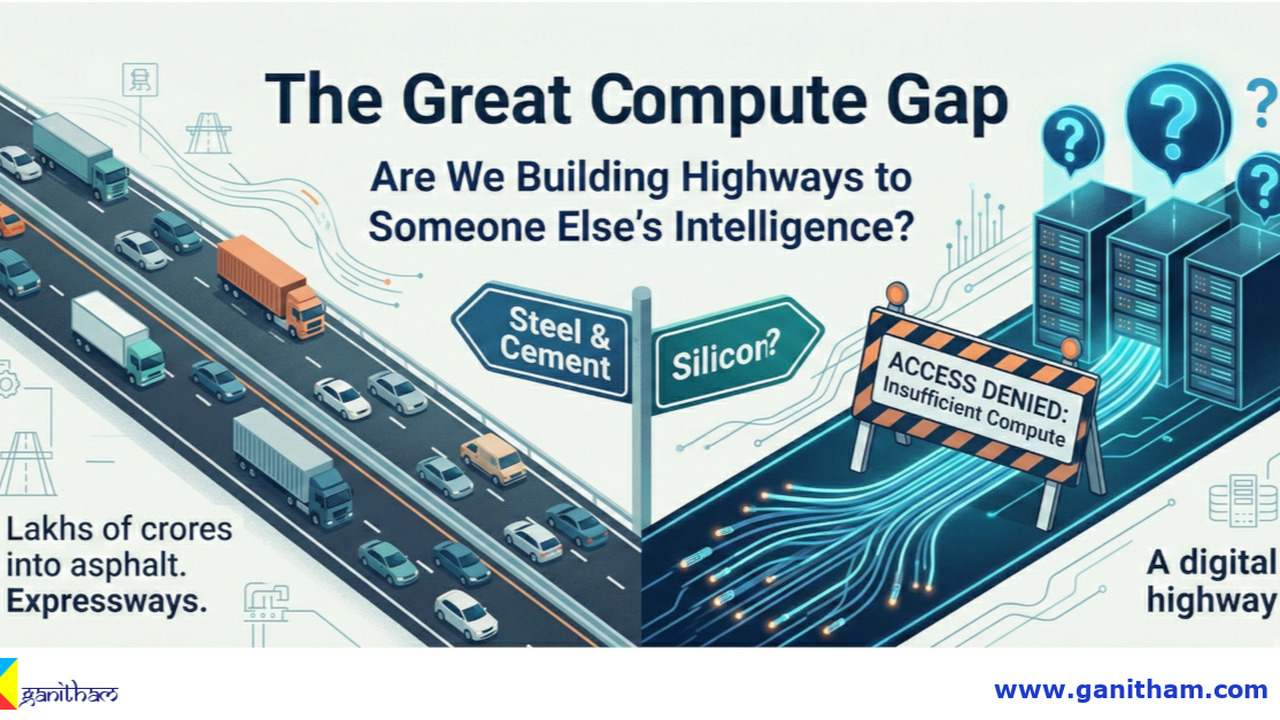
India is building highways at record speed.
Lakhs of crores into asphalt. Expressways. Freight corridors. Logistics grids.
And we should. A proud Indian, I am very pleased every time I use the express ways. I am very happy when I get overnight delivery of products which used to take weeks using lightning fast supply chains – recently built.
But here’s the uncomfortable question:
In 2026, what is real infrastructure? Steel & Cement? Or silicon?
In the February Budget, one contrast stood out:
We fund physical roads like a rising power should. ₹3.10 lakh crore (≈ $34.1 billion USD) for roads, ₹2.78 lakh crore (≈ $30.6 billion USD) for Railways.
We fund AI infrastructure like a pilot project. A meagre ₹1,000 crore (roughly $1.10 billion) for National AI Mission. We might say public private partnership is the future. That was our unsuccessful past in roads and rails. History has to repeat and we will invest once the opportunity is past?
And this imbalance or quick action may define the next decade for India.
This Is Not About Models. It’s About Infrastructure.
The US saw $109B in private AI investment last year. Hyperscalers are deploying GPU clusters at massive scale. Compute is concentrating.
And when compute concentrates, three things follow:
- Talent migrates
- Capital compounds
- Margins accumulate
Infrastructure creates gravity. Gravity decides where value lives.
The Compute Tax Nobody Is Talking About
India has a vibrant startup ecosystem. But every Indian startup is building on foreign LLMs is paying rent.
Every API call. Every fine-tune. Every inference.
We may call it innovation. But structurally?
It’s a digital tariff.
If your intelligence stack runs on foreign infrastructure, you are building on someone else’s rails.
And platform economics is ruthless.
Margins don’t accumulate at the edge.
Margins accumulate at the core.
The Real Risk
India generates enormous data. Finance. Healthcare. Logistics. Retail. Governance.
Where is that data refined? On whose silicon? Under whose pricing power?
Without sovereign compute at scale:
We export data. We import intelligence. We pay rent.
That’s not sovereignty. That’s dependency with better UX.
NITI Aayog projects AI could add $1.7 trillion to India’s economy by 2035. Great. And we want to support this with mere $1.1 Billion investment.
But here’s the harder question:
Add to whose balance sheet? GDP growth does not automatically equal value capture. If the infrastructure sits elsewhere, so will the leverage.
AI will not “kill” Indian IT.
But unmanaged infrastructure asymmetry could compress it.
History has seen this before.
And that’s where this gets interesting.
In Part 2, I share:
- What Manchester mills have to do with GPUs
- Why brain drain is actually an infrastructure problem
- And how India can still turn this into an advantage
Because this is not a story about fear.
It’s a story about leverage.
Where does this apply to you?
If something here resonates, we’re open to a thoughtful discussion.
Where to start
Every firm is different, so we start by listening. A 30-minute call is enough to see where AI fits first.
Book a 30-minute call